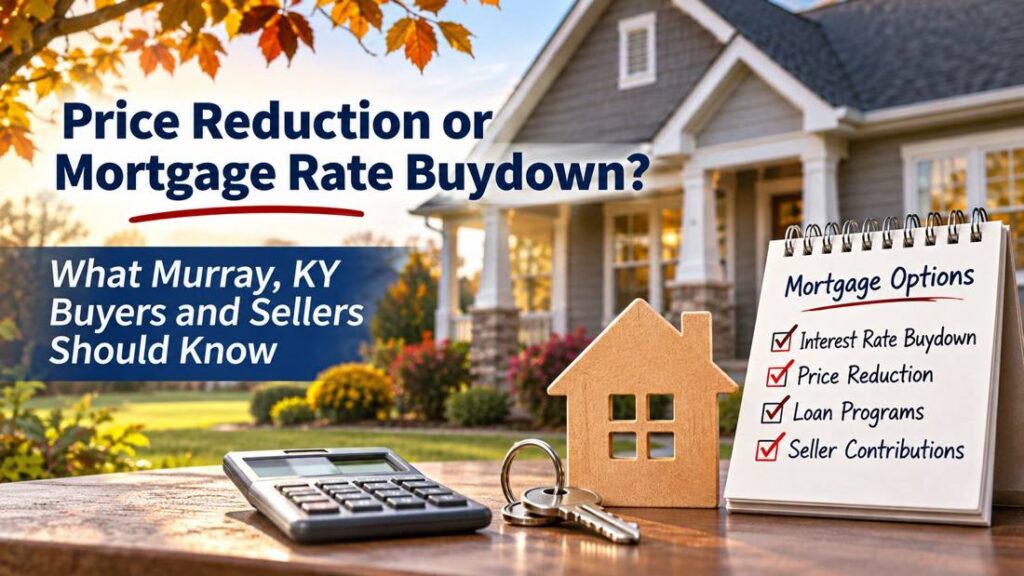
When a home hasn’t sold, lowering the price is often the first thing people think about. And sometimes, that is exactly what needs to happen.
But before deciding, there is another question worth asking: Could helping with the buyer’s mortgage costs make a bigger difference?
For someone buying a home in Murray or Calloway County, the monthly payment and the money needed at closing can matter just as much as the purchase price. For the seller, the question is what it takes to reach an agreement and what they will walk away with when the sale closes.
We wanted to take a closer look at how mortgage rate buydowns fit into that conversation. Pricing a home and negotiating an offer are part of our work every day. The finer points of mortgage programs and buydown rules are where we turn to a lender. So we reached out to Ben Helmerich, Vice President and Loan Officer with Gershman Mortgage, to help us explain those details accurately.
That is one reason we value having reliable people to call throughout a real estate transaction. Whether it is a lender, home inspector, insurance professional, or someone who can evaluate a repair, the right person can help answer questions that deserve more than a guess. Part of our job is helping you find those answers before you make a decision.
Here is what buyers and sellers should understand before choosing between a price reduction and a buydown.
What is a mortgage rate buydown?
With a buydown, money paid upfront helps lower the interest rate or cover part of the buyer’s payments. There are two main types, and it helps to understand the difference.
Permanent buydown: a lower rate for the life of that loan
A permanent buydown means paying an upfront fee, usually called discount points, to get a lower interest rate. A seller may be able to help cover that cost as part of the negotiated offer, if the loan program allows it.
The lower rate lasts for the life of that loan. If you refinance, you replace the mortgage with a new loan at new terms. The original discount-point fee is not refunded or transferred to the new mortgage.
The question to ask is: How long would you need to keep this mortgage for the monthly savings to make that upfront cost worthwhile?
Temporary buydown: lower payments for an introductory period
A temporary buydown helps with payments during the first few years. Money is set aside at closing to cover part of those payments, while the actual interest rate written into the mortgage, called the note rate, stays the same.
Depending on the program and lender, temporary buydowns may last one, two, or three years. Common structures include:
| Structure | Year 1 payment basis | Year 2 payment basis | Year 3 payment basis | Full note-rate payment begins |
|---|---|---|---|---|
| 1-0 | 1 percentage point below the note rate | Full note rate | Full note rate | Year 2 |
| 2-1 | 2 percentage points below the note rate | 1 percentage point below | Full note rate | Year 3 |
| 3-2-1 | 3 percentage points below the note rate | 2 percentage points below | 1 percentage point below | Year 4 |
Your lender can tell you which options your loan allows. The important thing is being comfortable with the full payment when the assistance ends, including taxes, insurance, and any mortgage insurance. You also have to meet the lender’s qualification rules. For example, Fannie Mae requires buyers to qualify at the full note rate.
What happens if you refinance during a temporary buydown?
This is an important difference from permanent discount points.
With a temporary buydown, some of the money set aside at closing may still be unused when the mortgage is paid off through a refinance or sale. Depending on the loan program and written buydown agreement, that balance may be credited toward the mortgage payoff rather than simply forfeited. Other treatment may be permitted under the agreement.
Ben explained that, with the arrangement he described, unused temporary buydown money would help reduce the amount needed to pay off the old mortgage when refinancing. Ask your lender to show you how your own agreement handles that money before you close.
We would never want someone buying a home on the assumption that they can refinance later. Rates and personal circumstances can change. Make sure the payment works for you even if you keep the original mortgage.
A $300,000 example: how the payments compare
Assume a $300,000 home, a 20% down payment, and a 30-year fixed mortgage at a hypothetical 7.00% interest rate.
These examples show principal and interest only. They exclude property taxes, homeowners insurance, mortgage insurance, HOA dues, and closing costs. They are illustrations, not current rate quotes.
| Option | Purchase price | Loan amount | Approximate monthly principal and interest |
|---|---|---|---|
| Original price at 7.00% | $300,000 | $240,000 | $1,597 |
| $10,000 price reduction at 7.00% | $290,000 | $232,000 | $1,544 |
| Original price with a permanent buydown to 6.50% | $300,000 | $240,000 | $1,517 |
The price reduction lowers principal and interest by about $53 per month. It also lowers the down payment by $2,000 when the buyer puts 20% down.
The illustrative permanent buydown lowers principal and interest by about $80 per month on the original loan amount.
These numbers show how the payments change. They do not mean a $10,000 seller credit will buy the rate down to 6.50%. Your lender needs to price the options for your loan before you can compare what the same amount of seller assistance would accomplish.
How a temporary 2-1 buydown could work
Using the same $240,000, 30-year loan with a hypothetical 7.00% note rate:
| Period | Payment calculated using | Approximate monthly principal and interest paid by buyer |
|---|---|---|
| Year 1 | 5.00% | $1,288 |
| Year 2 | 6.00% | $1,439 |
| Year 3 onward | Full 7.00% note rate | $1,597 |
The buydown account covers the difference between the subsidized payment and the scheduled principal-and-interest payment during the first two years. Based on these assumptions, the total subsidy would be approximately $5,594, calculated using unrounded payments. The lender determines the actual funding requirement.
That early payment relief may help a buyer manage the transition into homeownership. It also comes with scheduled payment increases. The full payment needs to fit the household’s budget from the beginning.
Can the seller pay for a buydown?
Often, a seller can agree to help with approved buydown costs or other closing expenses. You may hear that called a seller concession or seller credit.
The amount permitted depends on the loan program and transaction details, including down payment and occupancy. There is no single seller-contribution percentage that applies to every buyer.
A maximum allowance is a limit, not a promise that the seller will contribute that much. The buyer must also have eligible expenses to use the credit. Seller credits generally cannot replace the buyer’s required down payment, and unused credits generally are not cash the buyer can take home.
For example, Ben’s 2026 mortgage cheat sheet lists a 3% seller-contribution limit for a conventional primary or second-home purchase with less than 10% down. On his $170,000 purchase example with 3% down, that would be $5,100, subject to the applicable loan rules and valuation requirements. That allowance must accommodate the eligible seller-paid costs covered by the limit, so it cannot automatically all be allocated to a buydown.
If the buydown costs more than the loan allows the seller to contribute, the numbers will need another look. Getting the lender involved early helps everyone understand what can actually be used.
Before writing an offer, have the lender confirm how much assistance is allowed and how it can be allocated among closing costs, discount points, and any temporary buydown funding.
Ben’s loan example
Ben also shared the original charts below for a $170,000 purchase with 3% down on a conventional first-time homebuyer loan. We have kept his charts unchanged so you can see the figures he supplied.
These are a snapshot of one scenario, not today’s rate quote or a promise that another buyer will receive the same terms. The original images do not include column headings. Ask Ben to explain the pricing columns and the “Passed” and “Failed” labels before using these figures to make a financing decision.
Ben also provided a 2026 mortgage cheat sheet with seller-contribution limits and other program details. Your lender should confirm the rules that apply to your purchase.
When a price reduction may be the better choice
If a home is overpriced, we need to address the price. Offering help with financing will not make an unsupported asking price work, and the home still needs to meet the lender’s appraisal requirements.
A price reduction may also move a listing into another buyer’s online search range. For the buyer, it can mean a smaller down payment, less borrowing, and a lower balance to repay when selling or refinancing.
For some buyers, the more useful concession is help with eligible closing costs so they can preserve savings for moving expenses, repairs, and emergencies. That option belongs in the comparison too.
When a buydown may be worth considering
A buydown may be useful when the home is appropriately priced and monthly payment relief is a priority.
A permanent buydown deserves a close look when a buyer expects to keep the mortgage long enough to benefit from the lower rate. A temporary buydown may suit a buyer who can afford the full payment but values assistance during the first few years.
For sellers, either approach is a negotiated expense that reduces net proceeds. Ask for an estimated seller net sheet under each proposed structure. A price reduction and an equal-dollar credit may produce different net results because other transaction costs can change with the sale price.
Ask about the break-even point
For a permanent buydown, a simple starting calculation is:
Upfront buydown cost ÷ monthly payment savings = months to recover the cost.
For example, a hypothetical $6,000 cost that saves $80 per month has a simple break-even period of 75 months, or six years and three months.
That gives you a starting point, but it is not the whole picture. Ask your lender what the comparison looks like if you sell or refinance sooner. How long you keep the mortgage matters.
What should you ask your lender?
Before deciding, request a side-by-side comparison showing:
- A lower purchase price with no buydown.
- A seller credit toward eligible closing costs.
- A permanent buydown, including the actual upfront fee and break-even period.
- An available temporary buydown, including each payment increase and treatment of unused funds.
For each option, review cash to close, the loan amount, interest rate, APR, full monthly payment, and seller contribution required. Compare lender quotes using consistent assumptions and the same pricing date.
Buying or selling in Murray or Calloway County?
There is no one answer that fits every home or every buyer. Sometimes a price reduction makes the most sense. Sometimes help with closing costs or a buydown is worth considering.
Our job is to help you look at the options, ask the right questions, and understand what an offer means for you. With a knowledgeable lender involved, we can work through the financing details before you commit.
If you are thinking about buying or selling in Murray, Calloway County, or Western Kentucky, give us a call. You do not have to have it all figured out before we talk.
Tracy and Keith Williams
Williams Property Group | Benchmark Realty
Tracy: 270-293-3467
Keith: 270-293-3468
sellingmurrayky.com
Related reading
7 Mistakes to Avoid When Selling Your Home in Murray, KY
*Educational information only. Mortgage options, costs, eligibility, and seller-contribution limits vary by loan program and lender. Illustrations are not loan offers or current rate quotes.*
Click HERE for your cheat sheet!